Motor Inverter vs Motor Controller: What Is the Difference in a Washing Machine Drive System?
A motor inverter and a motor controller do different jobs, even though both may sit on the same drive board. The motor controller decides how the motor should run. It reads commands and operating feedback, then calculates speed, direction, torque, and protection actions. The motor inverter carries out those decisions by switching electrical power and supplying controlled current to the motor windings.
This motor inverter vs motor controller distinction matters when you design or source a washing machine drive system. If you treat both parts as the same item, you may receive the wrong hardware, miss important software requirements, or pair a suitable motor with an unsuitable control system.
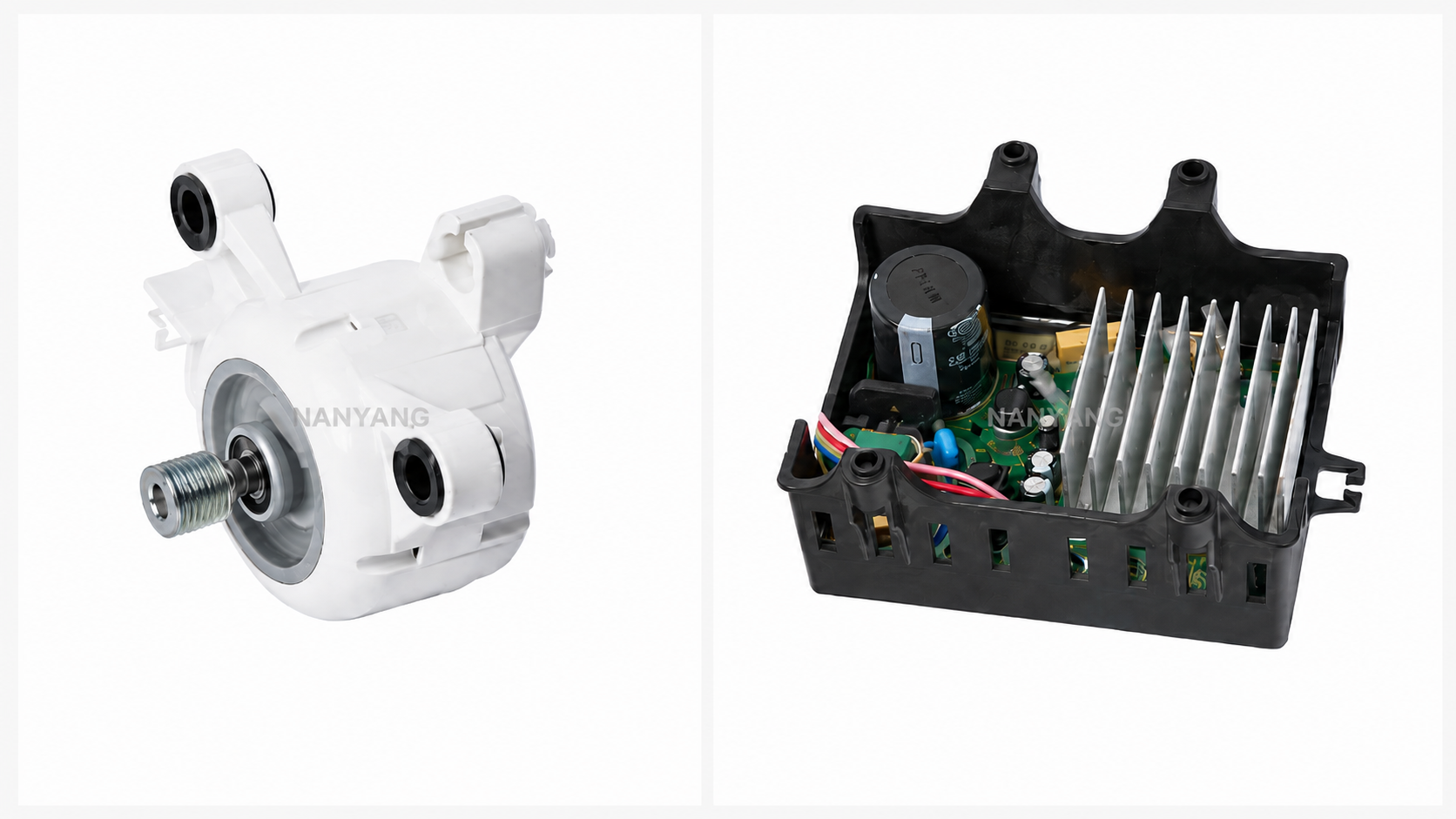
What Is a Motor Inverter in a Washing Machine Drive System?
The inverter is the power-handling part of the drive. It does not decide the wash program or judge whether the laundry load is balanced. Its job is to turn the controller’s commands into usable electrical output.
Power Conversion from AC Input to the DC Bus
A washing machine normally receives AC power from the mains. The electrical system rectifies that input and creates a DC bus. A large capacitor helps keep the DC voltage stable while the motor load changes.
The inverter then uses this DC power to produce the phase output required by the motor. This conversion allows one motor to wash slowly, reverse often, and later accelerate to a much higher spin speed.
Controlled Phase Output for Speed and Torque
Power switches inside the inverter turn on and off at high speed. Their switching pattern controls the current flowing through each motor phase.
The inverter does not choose that pattern by itself. It follows signals from the motor controller. When the controller asks for more torque, smoother acceleration, or a different direction, the inverter changes the phase current accordingly.
Heat, Current, and Protection Limits
The inverter carries real motor current, so heat is a practical limit. Power switches, the DC-link capacitor, PCB layout, heat sink, and enclosure design all affect continuous output.
A board may reach the required speed during a short bench test but overheat during repeated spin cycles. You should therefore check continuous current, peak current duration, cooling conditions, and protective shutdown settings, not only maximum speed.
What Does a Motor Controller Do in a Washing Machine?
The motor controller handles decisions rather than raw power. It receives the wash-cycle command, checks motor feedback, and tells the inverter how to respond. This is why it is often described as the brain of the motor drive system.
Control Logic for Washing and Spinning
During washing, the controller may request slow rotation, frequent reversing, and controlled acceleration. Before spinning, it may run several short movements to spread the load. During dehydration, it raises the speed while watching current and vibration-related changes.
The controller also manages deceleration and braking. A poor control program can make a mechanically sound motor start roughly or reverse with too much shock.
Feedback from Current, Speed, and Rotor Position
The controller needs feedback to compare the requested condition with the actual motor response. This may include phase current, rotor position, speed, DC-bus voltage, and temperature.
When a wet load becomes heavier or moves to one side of the drum, the required torque changes. The controller adjusts its commands rather than allowing the motor speed to fall without correction.
Fault Decisions Before Damage Spreads
Protection is more than switching the system off. The controller must identify what went wrong and choose a suitable response.
It may reduce torque, stop the inverter, report a fault, or prevent an immediate restart after overcurrent, high temperature, low voltage, abnormal position feedback, or a locked drum. Clear fault logic protects the motor, power board, and washer structure.
Motor Inverter vs Motor Controller: What Is the Real Difference?
The simplest comparison is decision versus execution. The controller decides what the motor should do. The inverter delivers the controlled power that makes the motor do it.
Power Execution vs Control Decisions
A motor controller receives operating commands and feedback. It calculates the required commutation, current, speed, and torque.
A motor inverter receives switching commands and DC-bus power. It then sends controlled voltage and current to the motor phases. Neither part normally delivers a useful washer drive on its own.
Inputs, Outputs, and Core Hardware
| Comparison Point | Motor Inverter | Motor Controller |
|---|---|---|
| Main Role | Switches and converts electrical power | Calculates motor behavior |
| Main Input | DC-bus power and switching signals | Wash commands and feedback |
| Main Output | Controlled phase current | Speed, torque, commutation, and protection commands |
| Core Parts | Power switches, gate circuits, capacitor, heat sink | Processor, firmware, feedback circuits, interfaces |
| Main Risk | Heat, overcurrent, voltage stress | Poor tuning, wrong feedback, unstable response |
This table also explains why replacing only one part does not always solve a washer problem. Rough starts may come from control settings, while shutdown during spinning may come from power-stage temperature or current limits.
Separate Boards and Integrated Driver Modules
Some systems place the motor controller and inverter power stage on separate boards. Others combine the processor, power switches, sensing, capacitor, and cooling parts inside one compact module.
This is where supplier terminology becomes less clear. One company may call the complete assembly an inverter, while another calls it a controller or driver. You should ask what is included instead of relying on the label.
This system-level view also fits the way نانيانغ موتور works with appliance projects. Founded in 1992, the company develops and manufactures motors for household appliances and new energy vehicles. Its work covers drive-system design, core component supply, motor production, control modules, testing, and assembly support. The company operates a 420,000-square-meter manufacturing base and reports annual capacity of 46 million home appliance motors and 4 million automotive motors. For a washer buyer, the useful point is not company size alone. It is the ability to discuss the motor, controller, components, and complete drive setup with one technical team.
How Do the Inverter and Controller Work Together?
Once the roles are clear, the next concern is coordination. A front-loading washer does not run at one steady speed. Every stage places a different demand on the motor drive.
الغسيل بسرعة منخفضة والعكس
Low-speed washing needs stable torque and smooth direction changes. The controller calculates the target speed and commutation timing. The inverter supplies the current needed to rotate the drum without sharp movement.
Weak tuning may cause shaking, delayed reversal, or uneven drum motion. Insufficient inverter current can also make the motor struggle with a heavy wet load.
Load Distribution Before High-Speed Spin
An uneven load can create strong vibration during spinning. The controller uses changes in speed and current to judge whether the drum is ready to accelerate.
It may rotate the drum several times, stop, and reverse before approving the spin stage. The inverter must follow these small torque commands accurately. Poor response at this point may lead to repeated balancing attempts or cancelled spin cycles.
Stable Acceleration, Braking, and Restart
During spin acceleration, speed rises quickly and the drive carries more electrical and thermal stress. The controller limits the acceleration rate and watches the feedback. The inverter must provide the requested current without overheating.
Controlled braking matters as well. Sudden stopping can place unnecessary stress on the drum and suspension. A matched drive slows the load in a planned way and handles restart conditions safely.
What Problems Appear When the Motor and Controller Do Not Match?
A motor may meet its own drawing, and a driver may pass its own test, yet the washer can still perform badly. Most matching problems fall into electrical, control, or thermal areas.
Electrical Matching Stops Overcurrent and Weak Torque
You should confirm DC-bus voltage, continuous current, peak current, winding resistance, inductance, pole count, back EMF, and required torque.
A wrong current limit may cause weak washing torque or early protection. A power stage with too little current margin may work with an empty drum but fail when the machine reaches its rated load.
Feedback Tuning Reduces Shaking and Rough Starts
The controller must match the motor’s rotor-position method and electrical characteristics. Incorrect commutation timing can create noise, vibration, poor starting, or unstable low-speed operation.
Testing should cover both directions, repeated starts, light loads, heavy loads, and unbalanced loads. A smooth no-load test is not enough for a washing machine motor controller.
Thermal Testing Prevents Spin-Cycle Shutdowns
The washer cabinet has limited space, and nearby parts may reduce airflow. You should test the driver inside the real machine rather than only on an open bench.
Check board temperature during long spin cycles, repeated wash programs, locked-rotor protection, and high ambient temperature. This is also where the company’s البحث والتطوير والدعم الفني can help with electromagnetic design, thermal work, prototype testing, and product adjustment.
How Should You Select a Washing Machine Motor Drive System?
Selection becomes easier once you stop treating the motor, inverter, and controller as separate catalogue items. Begin with the washer’s actual working conditions, then build the drive around them.
Start with the Drum, Load, and Wash Program
Provide drum capacity, drum diameter, transmission structure, washing speed, spin speed, starting torque, reversing frequency, target noise, and expected duty cycle.
These details tell the supplier much more than a simple motor power figure. Two washers with the same rated capacity may need different torque curves because their drums, belts, pulleys, and wash programs differ.
Check the Controller, Inverter, and Protection Scope
Ask whether the quoted unit includes the processor, firmware, power stage, current sensing, position feedback, heat sink, capacitor, connectors, communication interface, and fault protection.
You should also confirm who handles control tuning. A complete board without suitable software may still require extensive development before it can run your washer correctly.
Match Drivers with BLDC Motor as One System
For front-loading washer projects, the compact integrated السائقين unit combines BLDC motor control with visible power and cooling components. It adjusts commutation, speed, and torque according to the wash cycle. Its capacitor supports voltage stability, while the heat sink helps control board temperature.
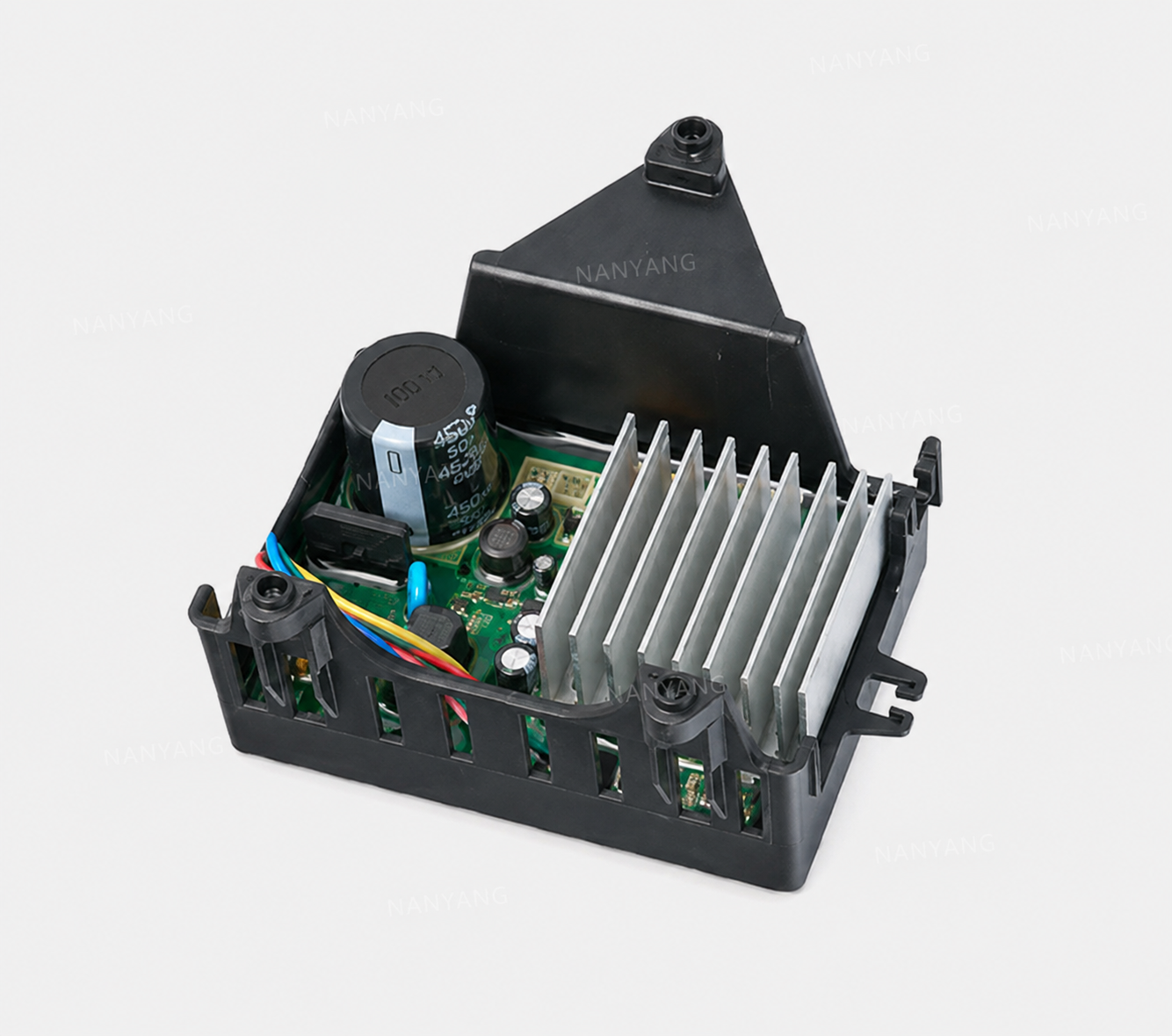
The matching BLDC المحرك uses electronic commutation and is available for 6–25 kg applications. The listed voltage is 310VDC, with a speed range of 0–17000 rpm. Its brushless structure reduces brush wear, while controller-based speed regulation suits the changing demands of washing and spinning.
Why Does a Matched System Lower Project Risk?
A matched motor drive reduces the number of unknowns during development. You have one set of electrical limits, one control strategy, and a clearer test plan. It also makes fault investigation much faster.
Manufacturing Control Supports Consistent Parts
Nanyang Motor produces key items such as enameled wire, stator and rotor cores, injection-molded parts, aluminum die-cast parts, and stamped metal parts.
This level of in-house production helps control motor dimensions, winding consistency, material matching, and repeatability. Those details matter when the same controller settings must work across a large production batch.
R&D and Testing Support Real Machine Conditions
A useful supplier should be able to move beyond a catalogue parameter sheet. Your project may need changes to winding data, current limits, cooling, connectors, control logic, or installation structure.
Drivers and BLDC Motor work best when tested with the real drum, load, suspension, wiring, and program. Complete-cycle checks can find issues that separate motor and board tests often miss.
Service and Contact Turn Specifications into a Usable Solution
The practical advantage of Nanyang Motor lies in pairing motor production with drive design, control support, component supply, and assembly experience. Drivers provides the control and power side, while BLDC Motor provides the mechanical output needed for washing, balancing, spinning, and braking.
For service, prepare your voltage, drum capacity, torque, speed range, interface, installation space, and testing requirements. You can then تواصل مع فريق المبيعات والهندسة for product selection, application support, configuration, customization, and quotation. A clear requirement sheet gives both sides a better starting point and reduces changes later in the project.
أسئلة متكررة
Q1: Is a Motor Inverter the Same as a Motor Controller?
A1: No. The controller calculates how the motor should operate, while the inverter switches power and supplies controlled current. Both functions may be integrated into one driver module.
Q2: Does a BLDC Motor Need a Motor Controller?
A2: Yes. A BLDC Motor requires electronic commutation. The controller sets the switching sequence, and the inverter power stage supplies current to the motor phases.
Q3: Why Does a Washing Machine Motor Shake at Low Speed?
A3: Common causes include incorrect commutation timing, poor rotor-position feedback, weak low-speed current control, unsuitable motor parameters, or mechanical load changes. Testing with the real drum and load helps locate the cause.
Q4: What Should You Check When Buying a BLDC Motor Driver?
A4: Check DC-bus voltage, continuous and peak current, motor winding data, feedback method, cooling, protection functions, communication interface, firmware scope, and complete-washer test support.
Q5: Which Products Fit a Front-Loading Washer Drive Project?
A5: Drivers and BLDC Motor can be matched as one drive solution. Nanyang Motor can review your washer capacity, speed, torque, voltage, control, and installation requirements before recommending a configuration.