What Is Better, Direct Drive Motor or Belt Drive Motor in a Washing Machine?
What Is Better, Direct Drive Motor or Belt Drive Motor in a Washing Machine?
Every washing machine depends on its motor as a central part. This component determines the force of the spin action, the amount of sound during nighttime operation, and the overall duration before any instability arises. Upon closer examination, the majority of these appliances employ either direct drive motors or belt drive motors as their primary configurations.
Many individuals find themselves weighing these alternatives. Such inquiries frequently arise during the selection process, especially when balancing silent function, enduring dependability, and initial expense. Often, the suitable choice hinges on one’s actual patterns of appliance utilization. To clarify this decision, it proves useful to review actual motor construction, manufacturing statistics, and extended practical insights from producers like Huzhou Nanyang Electric-Motor Co., Ltd.. This firm has manufactured washing machine motors on a broad scale since the 1990s. Today, it delivers tens of millions of units annually to markets across the world.
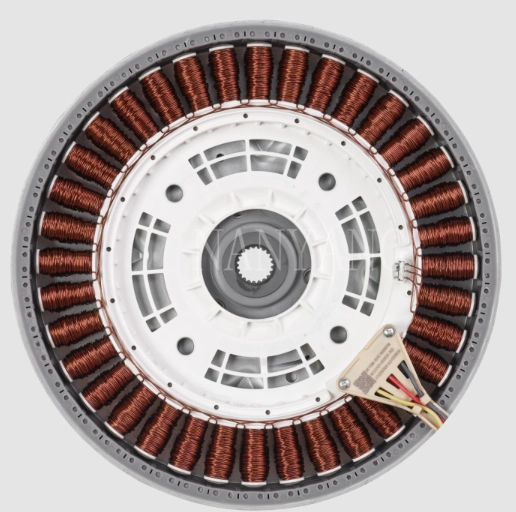
What Is a Direct Drive Motor in a Washing Machine?
A direct drive motor attaches directly to the drum of the washing machine. It avoids the use of belts, pulleys, or any intermediary transfer mechanisms. Consequently, the motor shaft and drum function as a unified rotating assembly.
This arrangement ensures that power transmission occurs with minimal waste. The torque applies straight to the drum’s motion, rather than dissipating through belt resistance. During typical washing routines, this results in steadier speed increases, more consistent handling at reduced speeds, and enhanced care for textiles in delicate settings.
Moreover, direct drive motors feature a more straightforward mechanical setup. With reduced components in motion, opportunities for degradation decrease. Data from extensive production testing indicates that eliminating belts and pulleys substantially lowers breakdown occurrences across prolonged periods of regular employment. Sound levels also improve noticeably. The absence of belt contact or pulley vibrations diminishes shaking, particularly in rapid spin phases.
For machines with substantial drum volumes, direct drive motors gain preference because they manage elevated weights without excessive pressure. Designs accommodating 20 kg or up to 25 kg capacities depend on this configuration to maintain equilibrium.
In this field, Huzhou Nanyang Electric-Motor Co., Ltd. maintains established production facilities for DD drum motors. These units target front-loading models and those with large capacities. Global appliance producers incorporate them extensively. To understand their assembly at the item level, the DD motor offerings appear in the company’s collection of washing machine motors. You can find them on the product pages.
What Is a Belt Drive Motor in a Washing Machine?
A belt drive motor employs a belt and pulley arrangement to convey power from the motor to the drum. This approach dates back several decades and persists in numerous current models.
Its primary strength lies in affordability. Producing belt drive setups remains less complex, and field replacements occur with relative ease. When a belt deteriorates, technicians can often swap it without disturbing the motor. As a result, starting costs for machines stay modest, and upkeep procedures prove uncomplicated.
Nevertheless, belts generate resistance. Gradually, this leads to energy dissipation as warmth and movement. Such inefficiency manifests in greater electricity demands over extended wash and spin periods. As belts elongate with age, rotation becomes irregular, and auditory disturbances increase.
Contemporary belt drive washers frequently integrate BLDC motors in place of conventional AC types. These BLDC units enhance power utilization and velocity management, even alongside belts. Based on comprehensive manufacturing records, BLDC belt configurations still require more energy than direct drive variants. However, the difference has diminished relative to past iterations.
BLDC motors compatible with belts form part of the domestic appliance motor lineup from Huzhou Nanyang Electric-Motor Co., Ltd.. Engineers craft them for extended operational spans. Producers often pair them with specialized electronic Drivers. This combination refines velocity precision and safeguards performance amid actual laundering scenarios.
Which Motor Type Offers Better Energy Efficiency?
When power consumption ranks as a top concern, direct drive motors generally perform superiorly.
Lacking belt resistance, these systems transform a larger portion of electrical input into effective drum rotation. Testing from production environments reveals that bypassing the transfer phase cuts overall system waste by a meaningful degree. This holds true especially amid frequent speed shifts in everyday wash sequences.
Belt drive arrangements forfeit some effectiveness via belt strain and pulley interaction. Across countless cycles, these inefficiencies accumulate. Despite advanced BLDC oversight, a segment of the supplied energy fails to engage the drum fully.
To counter this issue, unified motor and control unit designs grow prevalent. Configurations merging motors with compatible electronic Drivers elevate total effectiveness beyond 90 percent in operational washing appliances. Both direct drive and BLDC belt motors gain from this method. It has emerged as routine in high-volume fabrication at Huzhou Nanyang Electric-Motor Co., Ltd..
Durability and Maintenance: Which Is Better?
Considering upkeep perspectives, direct drive motors offer greater convenience across extended durations. They simply contain fewer elements prone to deterioration. Belts do not crack. Pulleys avoid loosening.
Belt drive motors, although trustworthy, demand routine checks. Belts degrade, extend, and occasionally skid. In moist laundry environments, this progression accelerates beyond anticipation.
Insights from prolonged appliance usage data suggest that direct drive motors endure better under intensive application. This applies particularly to homes conducting loads every day. Consequently, numerous upscale washing units now adopt direct drive as standard.
That being noted, endurance also relies on production standards. Units fabricated with internal stators, rotors, and accurate winding tools exhibit reduced flaw incidences. Huzhou Nanyang Electric-Motor Co., Ltd. documents flawless outcomes in various motor lines provided to leading appliance firms. Full-capacity evaluations and trackable quality protocols underpin this across millions of produced items.
Noise and Vibration: A Comparison?
Auditory output frequently influences purchasers in multi-unit residences or those operating devices overnight.
Direct drive motors achieve quieter performance inherently. The omission of belts and pulleys curtails mechanical echoing. Shaking reduces, notably in elevated-speed rotations. Practically, this equates to several decibels fewer in sound during maximum activity.
Belt drive motors generate additional mechanical audio, especially with aging belts. Despite effective cushioning, certain vibrations propagate to the enclosure.
Minimizing noise in motor engineering has drawn attention from washing appliance creators. DD motors from Huzhou Nanyang Electric-Motor Co., Ltd. incorporate refined stator forms and equilibrated rotors. These aim to maintain sound below typical home limits. When combined with suitable electronic Drivers, velocity transitions remain fluid. This further lessens perceptible shaking.
Cost-Effectiveness: Direct Drive vs. Belt Drive
Initial expenditure represents the domain where belt drive motors retain a clear edge. Their production proves more economical, thereby sustaining lower retail values for machines.
Direct drive motors demand higher starting investment. The units themselves possess greater size and intricacy. Nonetheless, across multi-year employment, circumstances shift. Decreased utility charges, reduced service needs, and prolonged functionality frequently compensate for the elevated acquisition outlay.
Within bulk manufacturing, harmonizing expense and capability holds significance. By overseeing essential elements internally and operating streamlined assembly processes, entities such as Huzhou Nanyang Electric-Motor Co., Ltd. narrow price disparities. They preserve elevated standards simultaneously. Thus, both direct drive and belt drive choices become feasible, aligned with financial plans and operational routines.
Conclusion: What’s the Better Option for You?
For those seeking subdued function, superior power savings, and limited servicing, direct drive motors typically serve as the preferable selection. They integrate effectively into advanced washing appliances and frequent-use domestic settings.
When starting costs take precedence and routine care poses no issue, belt drive motors continue as a dependable alternative. Up-to-date BLDC belt arrangements outperform legacy versions considerably. They ensure consistent daily laundering results.
Regardless of the path chosen, the caliber of the motor surpasses the fundamental framework in importance. Investigating comprehensive washing machine motor packages, encompassing units, regulators, and electronic Drivers, illuminates how varied systems adapt to practical demands. The extensive selections from Huzhou Nanyang Electric-Motor Co., Ltd. demonstrate ongoing advancements in both direct drive and belt drive methodologies.
FAQ
Q1: Is a direct drive motor always quieter than a belt drive motor?
A: In most instances, it proves so. The elimination of belts and pulleys diminishes shaking and mechanical sounds, particularly amid rapid spinning actions.
Q2: Do belt drive washing machines consume much more electricity?
A: They require additional power owing to resistance losses. Yet, current BLDC belt setups have lessened the disparity versus earlier configurations.
Q3: Which motor type lasts longer in daily household use?
A: Direct drive motors frequently persist longer. They feature fewer degradable components and milder mechanical pressures over periods.
Q4: Are electronic drivers important for washing machine motors?
A: Indeed. Appropriately paired electronic drivers bolster velocity oversight, power utilization, and safeguarding for direct drive and belt drive motors alike.
Q5: How do you choose between direct drive and belt drive motors?
A: The decision aligns with key priorities. Opt for direct drive to gain serene operation and sustained worth, or belt drive for modest initial outlay and effortless care.