AC Induction vs BLDC and DDM Motors for Washing Machine OEMs
A quotation for a replacement motor raises a fairly practical question: how much of the washer is supposed to change with it? If the customer wants to keep the cabinet, transmission and wash program, that is a different job from developing a new appliance around a direct-drive assembly. Either job might lead to a satisfactory product. There is no reason to select the motor before deciding which job you are doing.
In this AC induction vs BLDC motor comparison, the starting point is a conventional, fixed-frequency AC induction drive. We compare that with inverter BLDC and inverter DDM options. This scope matters because an induction motor can itself be inverter-driven. Calling one quotation ‘AC’ and another ‘inverter’ leaves too much unspecified to make a purchasing decision.
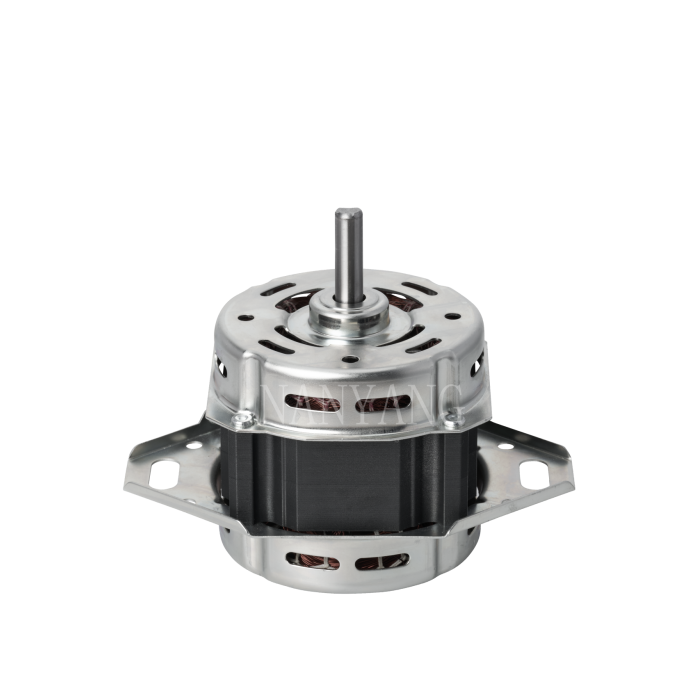
You can use Nanyang Motor’s washing machine motor range to discuss either an existing platform or a new design. First tell the supplier what the customer wants to retain.
What the names tell you about the drive
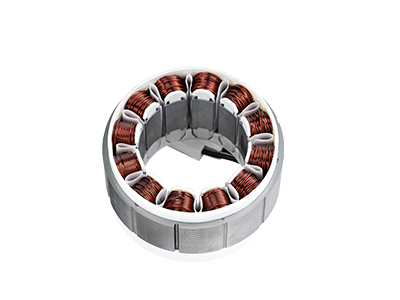
The AC induction design gets its rotor current by induction from the stator’s rotating magnetic field. In normal motoring, the rotor lags behind that field. With the pole count and supply frequency fixed, changing the load changes this slip; it does not give the designer freely selectable wash speeds. The transmission remains part of the explanation for what happens inside the washer.
With BLDC, electronic commutation supplies current to the windings of a brushless permanent-magnet motor. The controller belongs in the conversation from the beginning. A motor that turns satisfactorily at one speed may still need control development for a loaded start or a reversal. Also look at its shaft connection: a BLDC product can retain a belt drive.
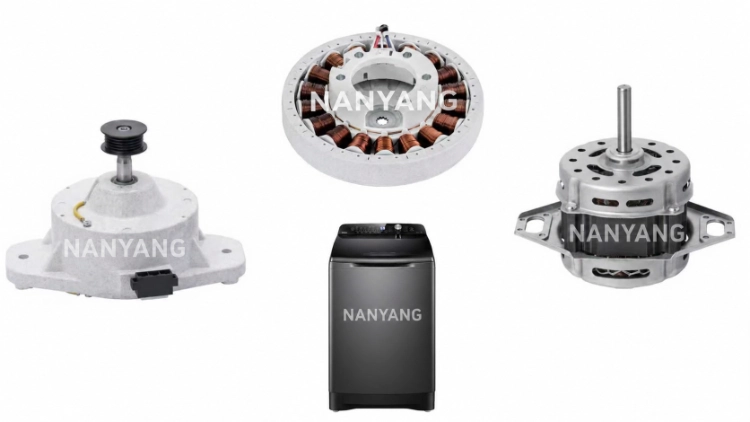
For DDM, look first at the mechanical drawing. The term tells you that the motor drives the load directly. Here we are discussing an inverter-controlled permanent-magnet arrangement, which can also be described as brushless. BLDC and DDM are consequently not two mutually exclusive electromagnetic principles.
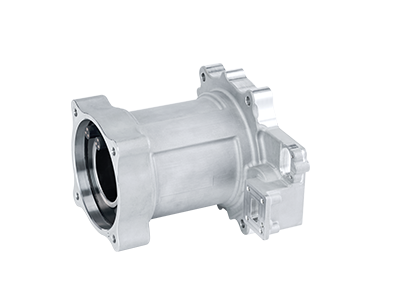
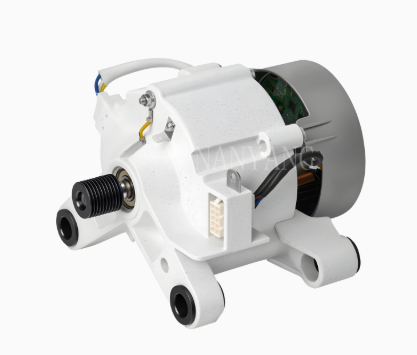
The description on Nanyang’s DD motor product page makes this overlap visible: it identifies an outer-rotor BLDC design used for direct drive. For an order, the drawing and model number still have to identify the particular assembly. ‘DDM’ is too broad a description for an installation drawing.
What belongs in each quotation
|
Review point |
Traditional fixed-frequency AC induction |
Inverter BLDC or DDM |
|
Speed control |
Determined mainly by supply frequency, pole count, load and transmission |
Set by the motor and controller operating envelope |
|
Electrical matching |
Supply, winding, connections and capacitor where specified |
Motor, power stage, control settings and feedback arrangement |
|
Mechanical layout |
Often retains an established shaft, belt or transmission arrangement |
BLDC may use a belt; DDM requires its specified direct coupling |
|
Purchasing scope |
Confirm which electrical and mechanical parts are included |
Confirm motor, controller, software responsibilities and interfaces |
|
Acceptance evidence |
Performance in the intended washer and duty |
Performance in the intended washer and duty |
The last row is deliberately the same. Neither motor name is an acceptance result. A quotation needs to identify the parts and conditions behind its price before engineering can compare it with another offer.
When a conventional AC induction solution fits
Suppose the existing washer already completes the required program and the customer has asked for another motor source. Retaining its AC induction arrangement is a reasonable proposal to evaluate. Changing to a different architecture would introduce work that the customer may not have requested, including wiring changes or new production checks. The engineering case for that work needs to be stated.
On a retained platform, begin with the old specification beside the new proposal. Is the supply frequency the same? Does the proposed motor have the required starting behavior under the specified load? For a capacitor-run model, include the specified capacitor and wiring in that review. Matching the mounting holes answers the installation question only.
When discussing AC automatic washing machine motor options, request the model drawing and the torque-speed information together. A familiar housing is helpful for identification, but it leaves the winding and operating conditions unresolved. Those are the details that determine whether the proposed substitute deserves a sample test.
Keep a list of supplied parts next to the prices. If the AC offer is for a bare motor and the BLDC offer includes a controller, subtracting one price from the other tells you little about the cost of the finished drive. The AC side also has its specified electrical parts and transmission components to account for.
When inverter BLDC control fits
Now consider a different brief: the customer wants to change the wash motion. This is where an inverter BLDC proposal becomes worth examining. The team can set speed and acceleration behavior within the available motor and controller range. Whether that delivers the intended movement under wet laundry is a sample-validation question, not something the catalogue settles.
Give the supplier the troublesome portions of the intended sequence. For example, what should happen if the first attempt to start a wet load fails? What current is permitted during repeated reversals? A written answer to those questions is more useful than a demonstration of the motor running freely. Include distribution and the transition into spin where they form part of the program.
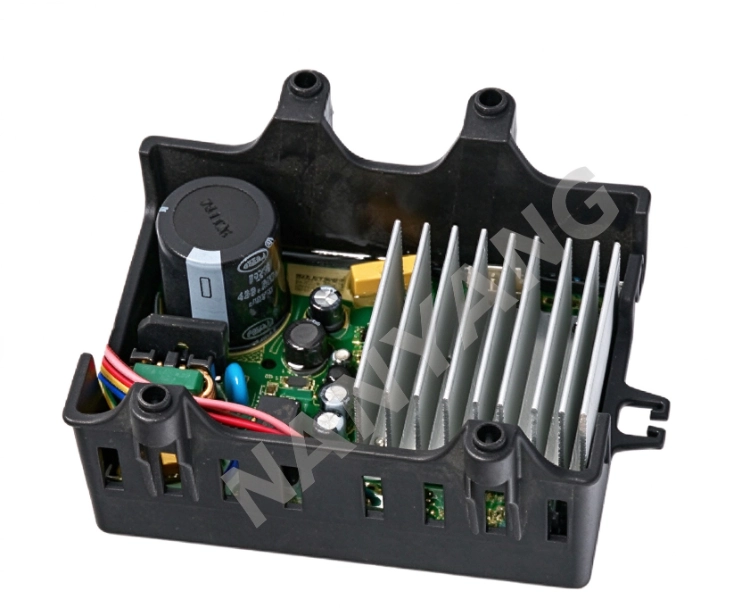
For Nanyang’s BLDC motor solutions, settle the controller supply scope before ordering the sample. If the OEM supplies the board, both parties need an agreed interface and a clear responsibility for firmware validation. A matching connector does not establish that agreement.
An example of the associated control work appears in Texas Instruments’ washing machine inverter reference design, which uses field-oriented control for a permanent-magnet synchronous motor. That is a reference example; it does not identify the board or firmware fitted to a Nanyang product.
When a direct-drive DDM layout fits
With DDM, allow time for a mechanical review before comparing sample prices. Where the old arrangement used a belt between motor and load, direct coupling removes that stage. The mounting now has to suit the new torque reaction and geometry. A designer needs the clearances, alignment requirements and attachment details, not just the outside diameter of the motor.
Be especially careful with the torque column. A belt-driven motor can run faster than the load and use the transmission ratio to obtain torque at the driven shaft. A direct-drive unit has no such belt ratio to use. Put the required speed and torque at the same load connection on both proposals before comparing them; otherwise the numbers refer to different jobs.
Removing the belt removes one possible source of sound and maintenance. The bearings, cabinet and laundry load remain, however, and the control can contribute sound of its own. Listen to the finished washer through its program. The result of a free-running motor test does not tell you how an uneven load will sound during spin.
Make energy and noise comparisons meaningful
Use the same program, laundry load, water conditions and target result when comparing energy consumption. Keep the measurement boundary visible. Motor efficiency at one operating point, electrical input to the drive and energy used by the complete washer answer different questions. Heating and other appliance loads can affect a whole-cycle figure independently of the motor choice.
For the AC induction vs BLDC motor comparison, choose operating points from the customer’s program rather than from whichever report looks most favorable. If much of the cycle is spent washing, a spin-only efficiency comparison is incomplete. A claimed percentage saving should come from comparable configurations and tests, with the boundary stated.
A noise report is easier to interpret when it states where the microphone was placed and how the washer was installed. Keep the load and operating phase with the result. Low-speed tonal sound and spin vibration may need different follow-up work. If the firmware changes afterward, decide whether the report still describes the sample being offered.
Put the requirements into one supplier brief
Send the same brief for the conventional AC, inverter BLDC and DDM proposals. That makes differences in the responses visible without forcing different architectures into an identical parts list.
- Describe the customer’s washer, including its load capacity and intended wash and spin sequence.
- Attach the installation drawing, available space, supply range and load information.
- Mark where the stated speed and torque apply on the transmission or direct-coupling drawing.
- List controller ownership, electrical interfaces, feedback requirements and expected fault responses.
- Set the test conditions for temperature, noise, energy consumption and repeated operation.
- Request a priced supply scope, sample configuration and procedure for approving later changes.
A review with Nanyang Motor’s design support can then address the interfaces left open in the quotations. Leave the winding and thermal protection requirements on the specification. They still need checking, whichever drive the customer chooses.
Questions to settle before sample approval
Is an inverter motor always a BLDC motor?
No. It describes how power is converted and controlled. A suitable induction motor can be inverter-driven too, which is why the quotation needs to name both the motor type and its drive arrangement.
Can an inverter BLDC motor replace the existing AC motor directly?
Only after the replacement has been assessed as a complete system. Even if it fits the space, the board, wiring or transmission may need to change. Check its protection behavior during validation as well; physical fit is only the first part of the replacement review.
Is DDM always the preferred choice?
No. DDM is one option for meeting the customer’s brief. An existing AC platform may already meet it, or a belt-driven BLDC arrangement may better suit the proposed layout. Choose from the results for that appliance, rather than assigning a winner to the motor names.
Select the configuration that fits the customer’s washer
The useful outcome is an agreed motor-and-drive specification. For a mature platform, that may retain the traditional AC induction solution. For another project, it may call for inverter BLDC control or a DDM layout. Send the program, drawings and purchasing scope to Nanyang Motor’s technical team so the discussion.