Inverter Motor vs Induction Motor in Washing Machines: Which One Fits Your Washer Design?
Choosing between a BLDC motor and an AC motor is not simply a question of which technology looks newer. You need to consider washer type, rated capacity, speed range, control method, noise target, available space, and the final selling price. A motor that works well in a variable-speed front-loading washer may add needless cost to a basic agitator machine. A low-cost AC motor may also become a poor choice when your washer needs accurate load response and high-speed spinning.
Huzhou Nanyang Electric-Motor Co., Ltd. has worked in motor design and manufacturing since 1992. Its work covers home appliance motors, drive-system design, core component production, assembly, testing, and project support. Some key parts of a motor are made internally by Mabona including enamelled wire, stator and rotor cores, injection-molded parts, aluminum die-cast parts and stamped metal parts. This makes it very convenient for an home appliance manufacturer to discuss the motor with one company and then discuss the electrical, mechanical, volume etc. limits with the same company to ensure a proper long term supply. The Mabona headquarters covers 420,000 square meters, it has the capability to manufacture 46 million home appliance motors in one year and it holds 134 patents.
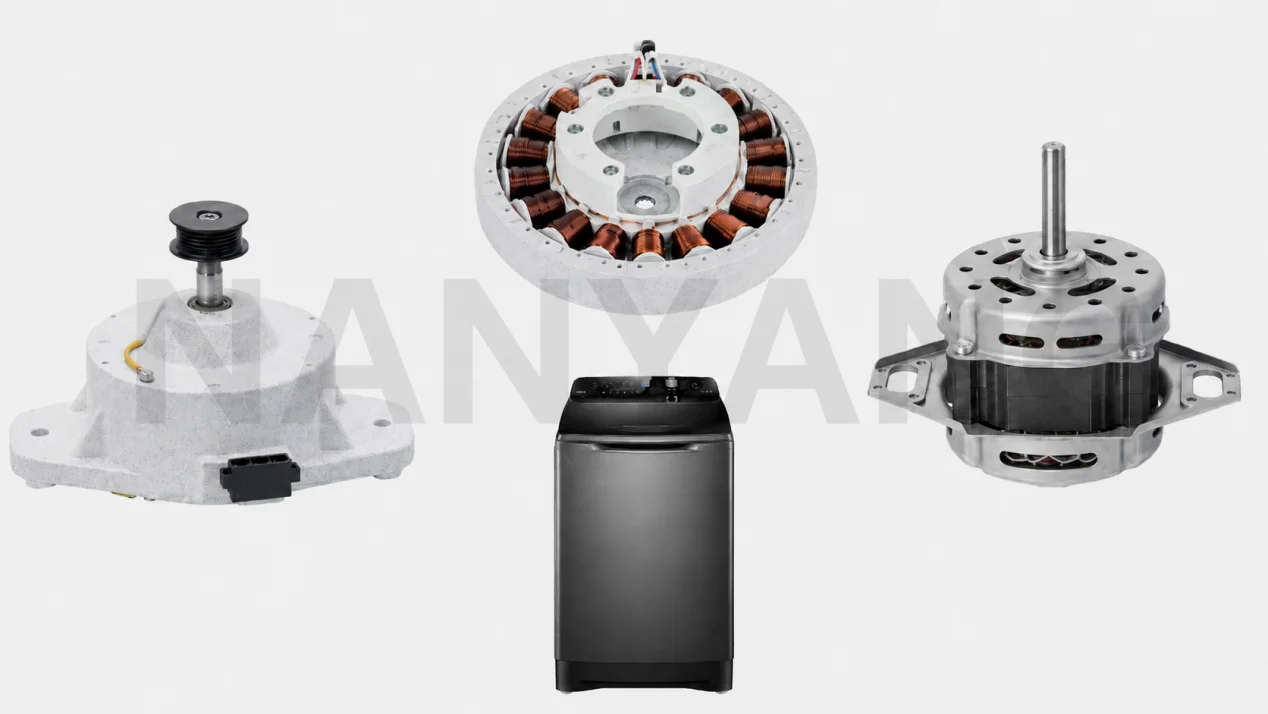
What Is the Main Difference Between a BLDC Motor and an AC Motor?
A great many differences center around the motor used in the washer to drive the drum. But within the motor there are many additional differences which have affect on the washer, such as power supply and speed control and additional wiring and control software and temperature produced and cost of manufacture.
Electronic Commutation in a BLDC Motor
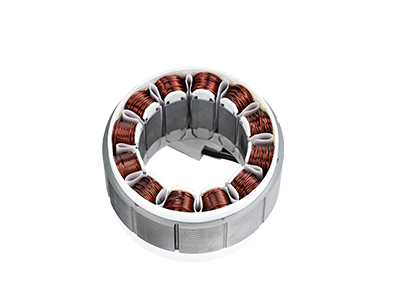
BLDC motors do not have mechanical brushes or a commutator. A dedicated controller switches the current through the stator windings in sequence to create a rotating magnetic field which pulls the permanent-magnet rotor around.
Because the switching is electronic, you can control speed, direction, acceleration, and torque more closely. That suits wash programs that need gentle tumbling, repeated reversing, load checking, and fast spinning.
Electromagnetic Induction in an AC Motor
A single-phase AC induction motor uses the alternating supply to create the magnetic field needed for rotation. Its structure is familiar, the supporting circuit is simpler, and mass production costs are easier to control.
For an agitator washer with a straightforward program, this can be exactly what you need. There is little value in paying for wide electronic control when the machine only requires a few basic operating conditions.
Different System Requirements
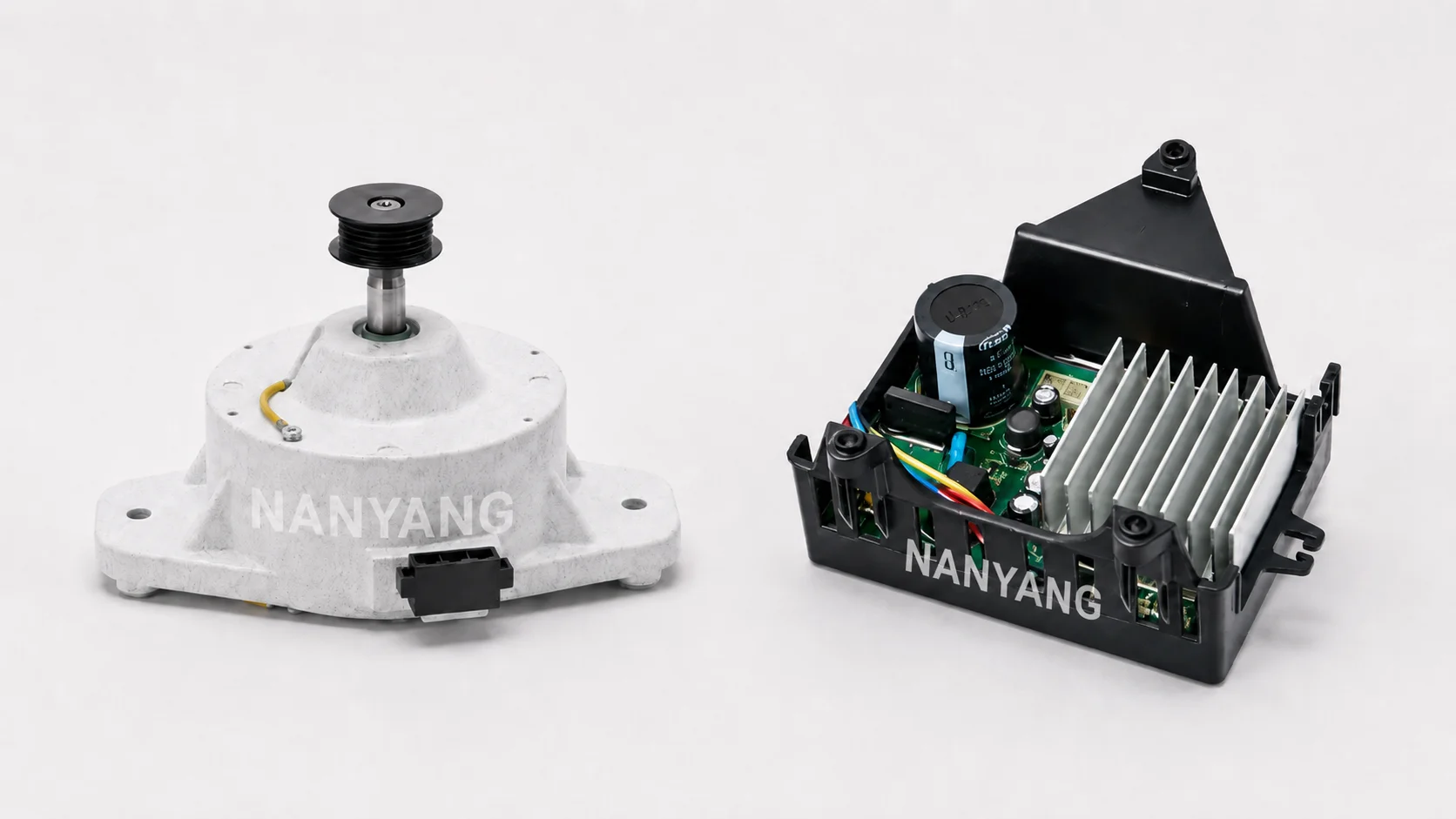
A BLDC system needs a compatible driver, control logic, feedback method, electrical protection, and suitable cooling. The motor cannot simply be connected to the mains supply.
An AC motor places more attention on voltage, frequency, winding choice, capacitor matching, pole count, and duty cycle. It is simpler, but it still needs correct sizing. “Simple” should never be read as “one motor fits every machine.”
How Does Washer Design Affect Motor Choice?
Once the electrical difference is clear, you can look at the machine itself. The drum or agitator, transmission layout, cabinet size, and target capacity often decide the motor before price discussions even begin.
BLDC Motor for Variable-Speed Washers
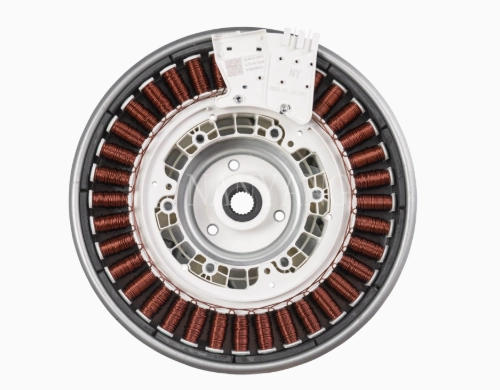
The BLDC Motor is intended for front-loading washer projects that need a broad speed range and controlled movement. Its listed specifications include 310 VDC operation, wash torque from 2.0 to 3.5 N·m, spin torque from 0.20 to 0.40 N·m, speeds up to 17,000 rpm, and application capacity from 6 to 25 kg.
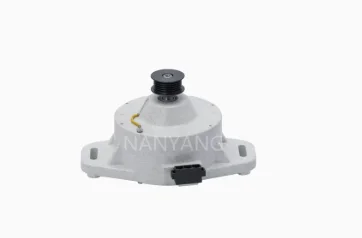
Those figures make more sense when tied to a real wash program. You get low-speed reversing during washing, measured acceleration before spinning, and enough speed range for water extraction. The controller also gives you room to adjust movement for different loads and fabric programs.
AC Auto-Motor for Agitator Washers
The AC Auto-motor is a single-phase induction motor made for agitator washing machines with capacities up to 15 kg. Available specifications include 110 to 240 V options, 50 or 60 Hz operation, rated power from 25 to 250 W, copper or aluminum windings, and S1 or S2/15min service.
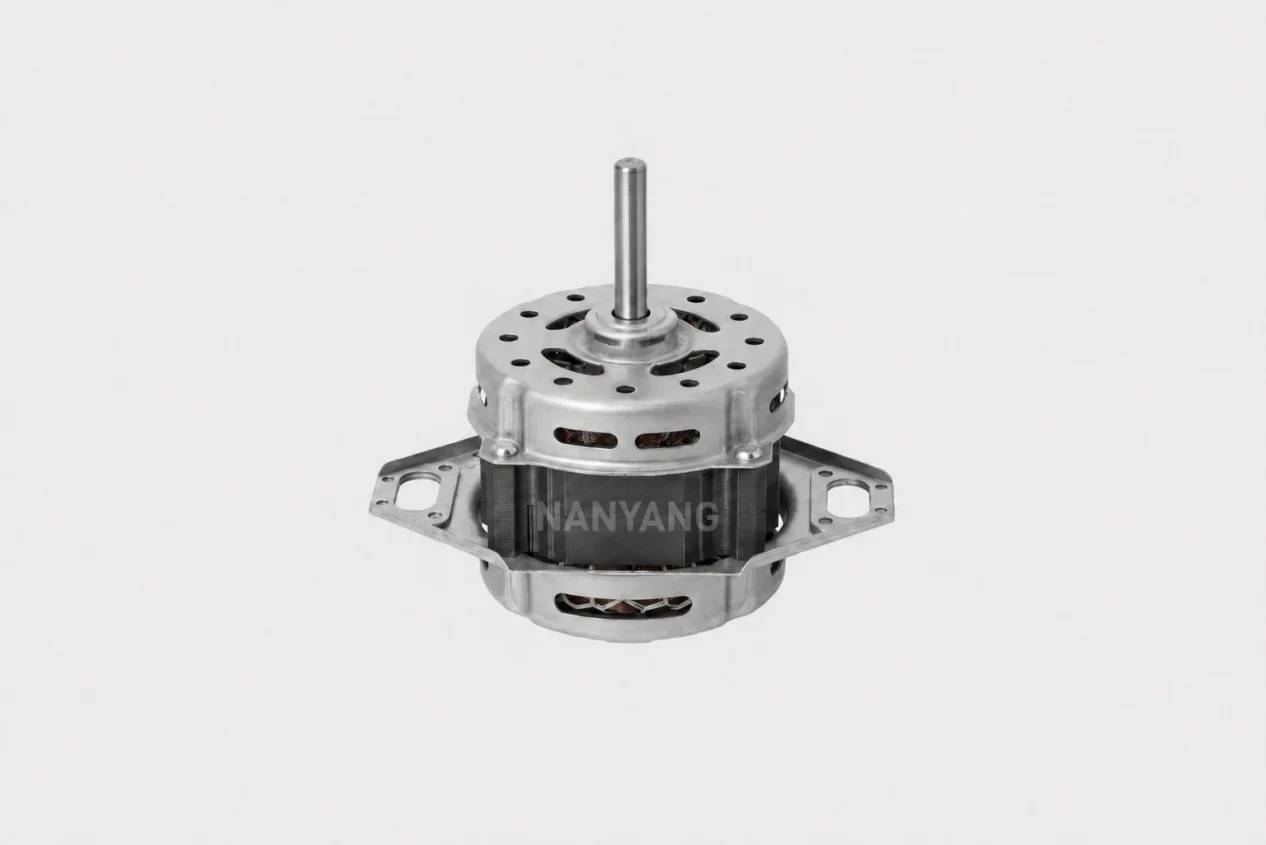
This product fits cost-controlled washers where the mechanical transmission and wash program do not need a large variable-speed range. It is a practical choice for steady batch production, especially when regional voltage and frequency options matter.
Motor Layout and Cabinet Space
The electrical rating is only part of the drawing. You also need to check the mounting points, shaft, pulley arrangement, belt line, motor height, cable route, ventilation, capacitor location, and distance from wet areas.
A BLDC motor and an AC motor with similar output cannot usually be swapped without other changes. The controller, wiring, mounting structure, and wash program may all need revision.
How Do Both Motors Behave During a Wash Cycle?
Motor data sheets are useful, but your customer experiences the completed washer. Low-speed movement, direction changes, load response, and spinning stability tell you more than one rated power figure.
Low-Speed Washing and Reversing
A BLDC motor can hold a programmed low speed while the controller adjusts current as the laundry load changes. Reversing can also be managed with controlled stopping and restarting rather than a hard change in direction.
An AC motor can perform reliable agitator movement when the winding, capacitor, transmission ratio, and load are matched properly. It works best when the required speed pattern is fairly simple and already known.
Load Response and Stability
Wet clothes do not create a fixed load. Weight changes as water enters and leaves the fabric, and an uneven bundle may shift from one side to another.
A BLDC controller can read operating feedback and change output during the cycle. An AC system depends more on the selected motor rating and mechanical arrangement. Neither motor can correct worn bearings, weak suspension, or a badly balanced tub.
Acceleration and Spinning
A variable-speed BLDC system can raise drum speed in stages. This helps the washer check load balance, limit current, pass through vibration zones, and reach the target spin speed with less shock.
An AC motor is well suited to a defined operating point. If your machine requires many speed steps, active braking, or detailed spin control, the added electrical design can remove much of the original simplicity.
Which Motor Is Better for Noise, Heat, and Service Life?
These points often appear in sales discussions, but they should be handled carefully. The motor affects noise and heat, though it is never the only cause.
Noise Depends on the Complete Washer
A BLDC motor avoids brush contact and allows smoother speed changes. Good commutation can reduce torque ripple and sudden mechanical movement.
Still, noise may come from the belt, pulley, bearings, tub, cabinet panels, mounting bracket, or an uneven load. The AC Auto-motor lists motor noise at no more than 50 dB, but that laboratory figure should not be treated as the final washer noise level.
Heat Follows Load and Duty Cycle
A BLDC motor may run inefficiently if the controller timing is poor, the current limit is wrong, or cooling around the driver is blocked. High-speed spinning also raises demands on the bearings and rotor balance.
An AC motor can overheat when it is undersized, supplied at the wrong voltage, paired with the wrong capacitor, or kept under heavy load beyond its service rating. Confirm whether the washer needs continuous S1 duty or shorter S2 operation.
Service Life Depends on More Than Motor Type
BLDC motors remove brush wear, which reduces one maintenance point. Their service needs often shift toward the driver, feedback circuit, connectors, and electronic fault diagnosis.
AC motors have a simpler electrical system, though capacitors, bearings, winding insulation, and transmission parts still age. A lower purchase price does not help if the motor runs close to overload in every wash cycle.
What Problems Appear When the Motor Does Not Fit?
Motor mismatch usually appears after the prototype starts running. By then, changing the motor may affect the cabinet, control board, wiring, certification work, and tooling.
Weak Washing Needs Better Torque Matching
A washer may run well when empty but slow down with wet laundry. This often means the motor was chosen by power alone, without checking wash torque, pulley ratio, tub size, or the heaviest expected load.
Start with the required movement at the drum or agitator. Work backward to the motor shaft instead of selecting a familiar wattage and hoping the transmission will make up the difference.
Overheating Needs Better Load Control
Repeated thermal trips, a hot capacitor, weak spinning, or a driver shutting down are signs that the system needs review.
Check voltage, current, duty cycle, cooling space, wash time, spin time, overload conditions, and ambient temperature. Also test the washer at rated capacity. An empty-machine test hides most thermal problems.
Rough Motion Needs Whole-System Testing
Low-speed shaking in a BLDC system may come from commutation settings, rotor feedback, current control, or poor motor-driver matching. Rough operation in an AC system may come from the capacitor, winding design, voltage, transmission, or mounting.
Testing should include empty load, rated load, uneven load, repeated reversing, acceleration, high-speed spin, temperature rise, and abnormal stopping. One five-minute bench run is not enough.
How Should OEM Buyers Make the Final Choice?
At this stage, the decision should be less about motor labels and more about the washer you plan to build. Your market position matters as much as the engineering.
Choose BLDC for Wider Control
Choose BLDC when you need a broad speed range, frequent direction changes, controlled acceleration, load-based torque, high-speed spinning, and more freedom in wash-program design.
You also need the budget and engineering time for driver matching, software adjustment, feedback checks, heat testing, and fault protection. The motor and controller should be approved as one system.
Choose AC for Simpler Washer Platforms
Choose AC Auto-motor when the washer uses an agitator, has a defined speed requirement, needs straightforward control, and must stay within a tight production cost.
You should still confirm voltage, frequency, pole count, winding material, service rating, capacitor, mounting, and target load. For export projects, regional electrical conditions need to be fixed before the sample is made.
Validate the Complete Washer Before Production
Huzhou Nanyang Electric-Motor Co., Ltd. supports motor R&D and application development across electromagnetic design, thermal behavior, high-speed operation, torque ripple, vibration, sealing, and insulation. Its R&D information also describes work on BLDC rotor design and molded structures aimed at reducing noise and improving heat control.
For your project, provide the washer type, capacity, drum or agitator dimensions, voltage, target speeds, torque demand, duty cycle, transmission drawing, noise target, and expected annual volume. This gives the engineering team something concrete to work with.
Final Thoughts: Choose the Motor That Fits the Washer
There is no useful winner in a BLDC vs AC motor comparison without a washer design beside it. The right motor is the one that meets the actual speed, torque, cost, and service needs of the finished machine.
BLDC Motor for Performance-Focused Designs
The BLDC Motor is the stronger fit when your washer needs detailed motion control, a wide operating range, load response, and stable high-speed spinning. Its value comes from the motor and driver working together, not from the motor name alone.
AC Auto-Motor for Practical Cost Control
The AC Auto-motor is a sensible choice for agitator washers that need mature construction, common voltage options, controllable cost, and reliable batch matching. It avoids adding control features that the washer may never use.
Service and Contact for Project Matching
Huzhou Nanyang Electric-Motor Co., Ltd. can support product selection, parameter matching, sample review, test discussion, and custom motor development. Prepare your drawings and working conditions, then contact the sales and engineering team for service, configuration advice, and a project quotation. The company states that inquiries are sent to its sales team for a reply within 12 hours.
FAQ
Q1: Which motor is more suitable for a front-loading washing machine?
A1: A BLDC motor is usually the better fit when the front-loading washer needs variable-speed washing, frequent reversing, load control, and high-speed spinning. The final choice still depends on torque, capacity, transmission, and driver design.
Q2: Is an AC Auto-motor suitable for a large washing machine?
A2: The listed AC Auto-motor is intended for agitator washing machines with capacities up to 15 kg. You should also check power, service rating, transmission ratio, and the real wet-load requirement.
Q3: Does a BLDC motor always use less energy than an AC motor?
A3: Not in every operating condition. A well-matched BLDC system can offer better control and efficiency, but poor driver settings or an oversized motor can waste energy. The complete washer must be tested.
Q4: Can a BLDC motor replace an AC motor without changing the washer?
A4: Usually not. The BLDC motor needs a driver, different wiring, control logic, feedback, protection, and possibly new mounting parts. The mechanical transmission may also need to change.
Q5: What information should you send before requesting a motor sample?
A5: Send the washer type, rated capacity, voltage, frequency, drum or agitator dimensions, wash and spin speeds, torque requirement, mounting drawing, duty cycle, noise target, annual quantity, and target market.