From High-Speed Spin to Standstill: What Washer OEMs Should Check
Why the Spinning Drum Must Be Braked
A washing machine drum is brought to rest by a brake that acts when the drum is running at spin speed, so that the door can be opened and the wet load taken out without danger to the user.
Braking Methods Used in a Washing Machine
Three arrangements are found in production machines: a friction brake acting on a disc or drum keyed to the shaft, a motor brake in which the controller produces the retarding torque, and the two together in which the friction brake holds the drum after it has stopped.
In the first arrangement a brake shoe or band acts on a braking surface fixed to the drum shaft. The energy absorbed is that of the drum and load, and the brake must be able to dissipate it without overheating.
In the second arrangement the motor slows the drum down.
Brake Components of the Washer Drive
The parts that carry the braking duty are the friction lining, the drum or band that the lining acts on, the spring or lever that applies it and the electromagnet that holds it off.
The wear of the lining is a function of the energy absorbed and of the temperature reached. The temperature rise depends on the mass and specific heat of the parts that the lining rubs against, as well as on the lining itself.
Friction linings are commonly made in the form of moulded, woven or sintered shapes.
The choice of lining has to take into account the fact that the coefficient of friction varies with speed, temperature and pressure. Deterioration of the lining is caused by overheating and by the absorption of moisture, oil or grease.
Stopping Time from Spin Speed
The stopping time is the moment of inertia of the drum and load multiplied by the change in angular velocity and divided by the braking torque, so a heavier load and a lower torque both lengthen it.
The moment of inertia of a washing machine drum can be calculated from its dimensions and mass, but since the load is distributed inside the drum as well as possibly being in the form of water, the maker’s figure for the maximum load inertia must be used.
In addition to the drum, the motor rotor and the gearing or driving belt contribute to the moment of inertia and must be included.
For the stopping time, it must be remembered that the speed of the drum at the start of braking is not necessarily the full spin speed; for example, after the spin sequence has been interrupted by a power failure, the drum may be at any speed.
If the motor is braked by a resistor or resistors connected across its line terminals, it acts as a generator at first. The energy taken out of the drum is dissipated in the resistor.
If a DC voltage is applied to the terminals of a three-phase induction motor, it produces a stationary magnetic field that brakes the drum whatever the direction of rotation. The braking torque is large at high speed and falls as the speed falls.
Tests on the Finished Machine
The finished machine is checked for stopping time at full spin speed, for the temperature rise of the winding, for lining wear, for noise and for the speed at which the door interlock releases.
The stopping time must be short enough for the door interlock to remain locked until the drum has stopped or reached a safe slow speed.
With the electro-mechanical brake, the clearance between lining and braking surface must be checked.
The temperature rise of the brake must be kept well below the point at which the lining fades or the components distort.
If the friction lining is contaminated with oil or grease, the brake torque falls.
If the spring that applies the brake weakens, the torque falls as well.
If the electromagnet is energised when it should be off, the brake will not act.
Brake Faults and Their Causes
The first sign of a fault is usually a longer stopping time than the machine showed when new, and the usual causes are a worn or contaminated lining, a weak spring or a controller that no longer delivers the braking current.
If the brake is noisy and chatters, the braking surface may be scored.
If the brake is applied by a spring and released by a magnet, a magnet coil that is open-circuit will leave the brake applied, with the result that the drum will not turn at all.
The clearance between lining and braking surface is checked and adjusted.
A lining contaminated with oil or grease is replaced.
The braking surface is cleaned with a non-greasy solvent.
The door interlock must not permit the door to be opened until the drum has stopped.
If the drum can be turned by hand when it should be locked, the interlock is faulty.
Door Interlocks and Safety Devices
The interlock is released on a measured drum speed, which is why the position signal from the motor is used for the release point and not a fixed delay after the brake is applied.
If the interlock is released by a timer alone, a slow stopping time will let the user open the door while the drum is still turning.
The interlock must also hold the door closed while the drum is turning at speed.
The door should not release the drum until the drum is below a safe speed.
Informazioni su Nanyang Motor
HUZHOU NANYANG ELECTRIC-MOTOR CO.,LTD. was founded in Nanxun, Zhejiang, in 1992 and has worked in the motor industry for more than 30 years. The company has more than 2,000 employees and 5 production bases, and holds 109 patents, of which 21 are invention patents.
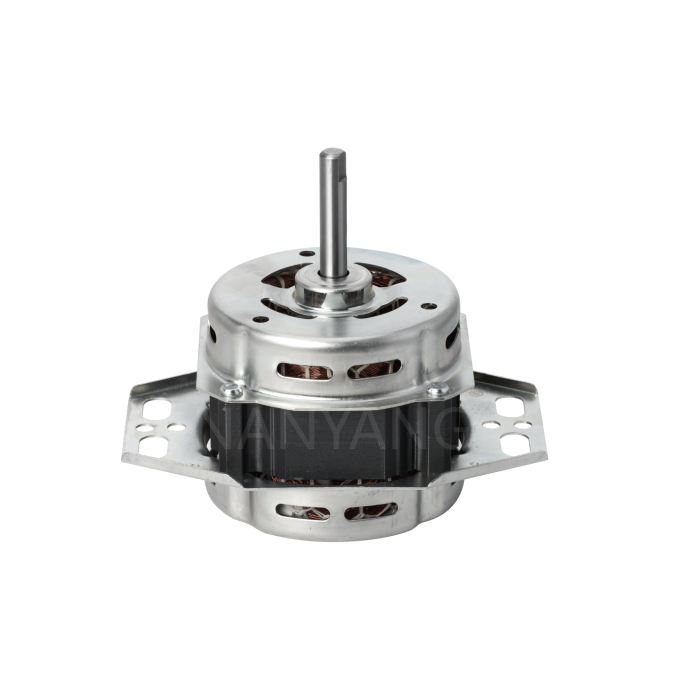
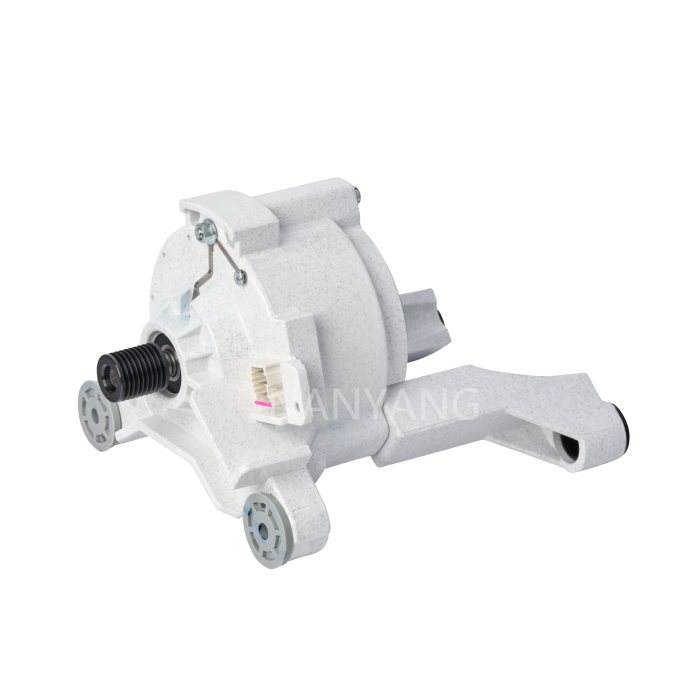
Il washing machine range covers a drum BLDC motor for machines up to 20 kg, a DD direct drive motor for drum machines up to 25 kg, a top-loading AC induction motor for machines up to 15 kg with a power range of 30 to 250 watts, and a DDM direct drive motor for pulsator machines up to 25 kg. The front-loading BLDC and DD motors are quoted at 7/10 to 1 HP and 220-240 volts, with a stated washing efficiency of 68 per cent or more and a dehydration efficiency of 75 per cent or more. The DDM motor for top-loading machines runs at 58 dB or less.
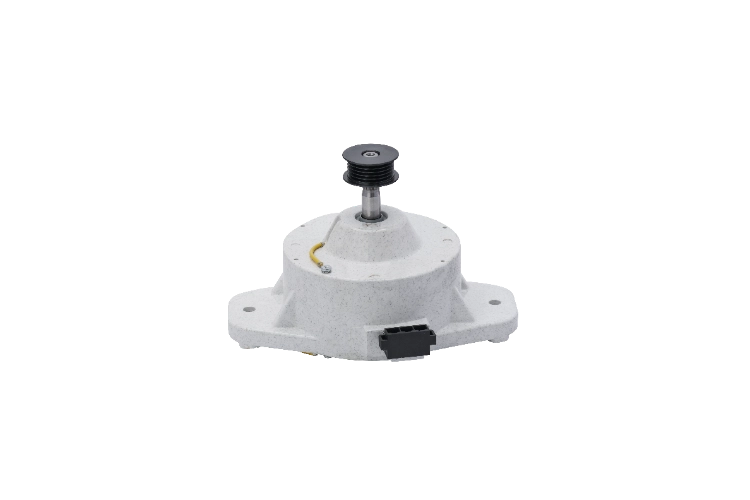
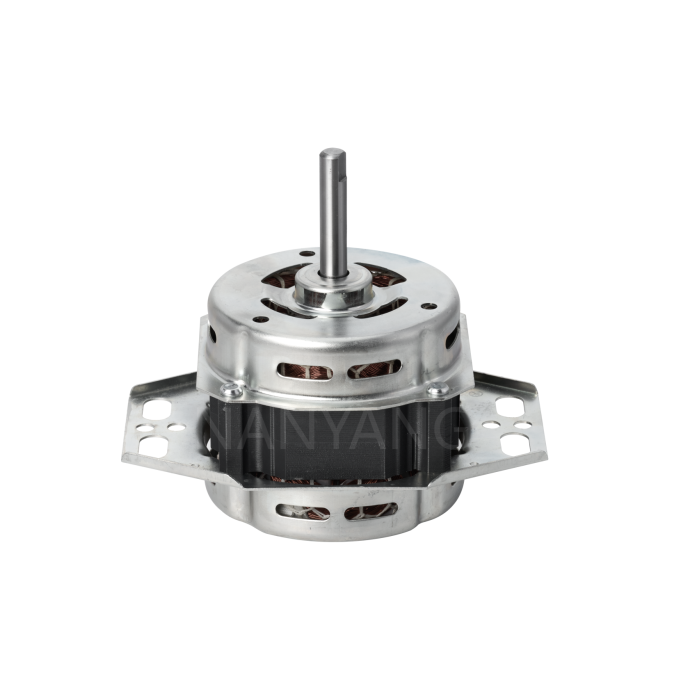
Nanyang top-loading AC induction motor
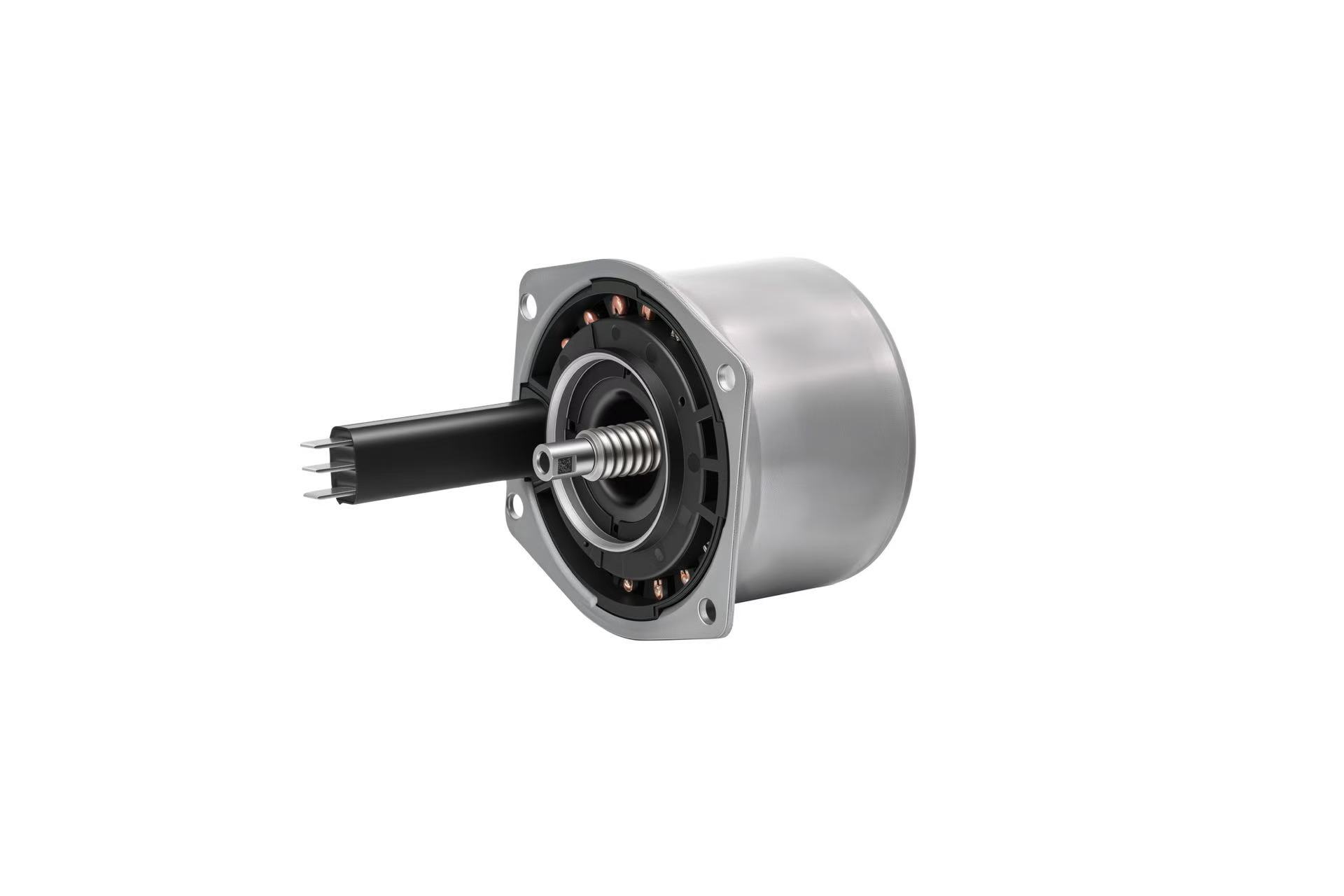
Nanyang front-loading BLDC washing machine motor
The company operates 54 variable frequency motor production lines, covering DD, DDM, BLDC and dryer motors. Nanyang washing machine inverter motors hold 35 per cent of the Chinese market and 15 per cent of the global market, and the company supplies Haier, Samsung, Midea, Hisense, TCL, Xiaomi, Panasonic and Sharp, with products sold to more than 30 countries and 48 per cent of output exported. Appliance motors carry CCC, CE and UL certification, and the company operates ISO9001, ISO14001 and IATF16949 management systems. Each motor carries a unique barcode for after-sales traceability.