Wash Motor vs Spin Motor: What Is the Difference in a Twin-Tub Washing Machine?
A wash motor and a spin motor do different jobs in a twin-tub washing machine. The wash motor reverses a pulsator or agitator through a washing cycle, while the spin motor accelerates the separate spin basket to remove water. Similar voltage or wattage does not make the two motors interchangeable.
That distinction matters to appliance designers, spare-parts distributors, and purchasing teams. A motor that fits the mounting holes may still have the wrong shaft, starting behavior, duty, rotation pattern, torque-speed curve, or driven mechanism. Treating both parts as a generic washing machine motor can create noise, slow starting, overheating, or an assembly that never reaches its target motion.
The practical way to compare a wash motor vs spin motor is to begin with the driven load, then confirm electrical ratings and mechanical interfaces. These differences directly affect product specifications, supplier selection, and sample approval.
What Does Each Motor Do in a Twin-Tub Washer?
A twin-tub washer separates washing and water extraction into two tubs. This layout allows each motor and mechanism to be selected for a narrower operating task.
The Wash Motor Reverses the Washing Mechanism
The wash motor drives the pulsator or agitator that moves water, detergent, and textiles. It normally works through repeated forward and reverse periods rather than one long run at maximum speed. The motor must start against a changing wet load and tolerate frequent directional changes during the wash timer sequence.
For a buyer, the important points include loaded starting torque, reversal behavior, capacitor or switching arrangement, thermal rise, and the transmission between the shaft and washing mechanism. The useful output is controlled wash motion, not simply the highest available speed.
The Spin Motor Drives the Extraction Basket
The spin motor drives the separate basket used for centrifugal water extraction. Its job is to accelerate the basket and wet load, maintain stable rotation, and operate within the vibration and safety limits of the appliance.
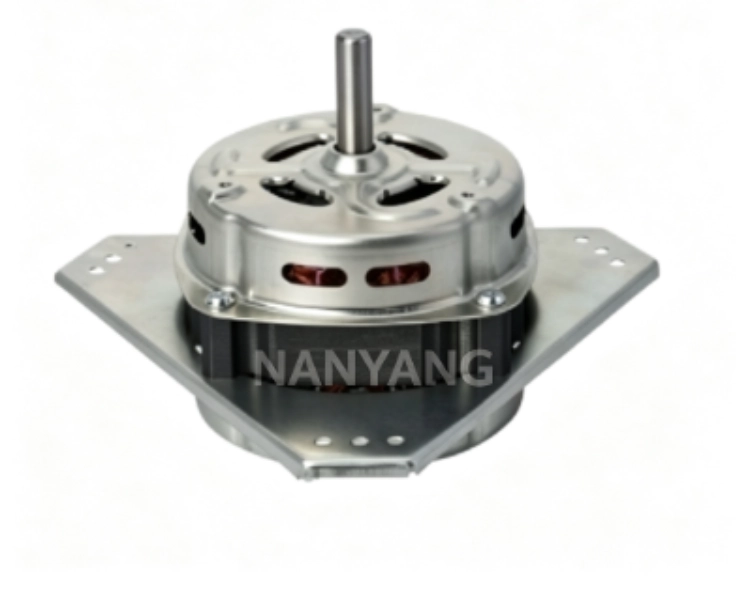
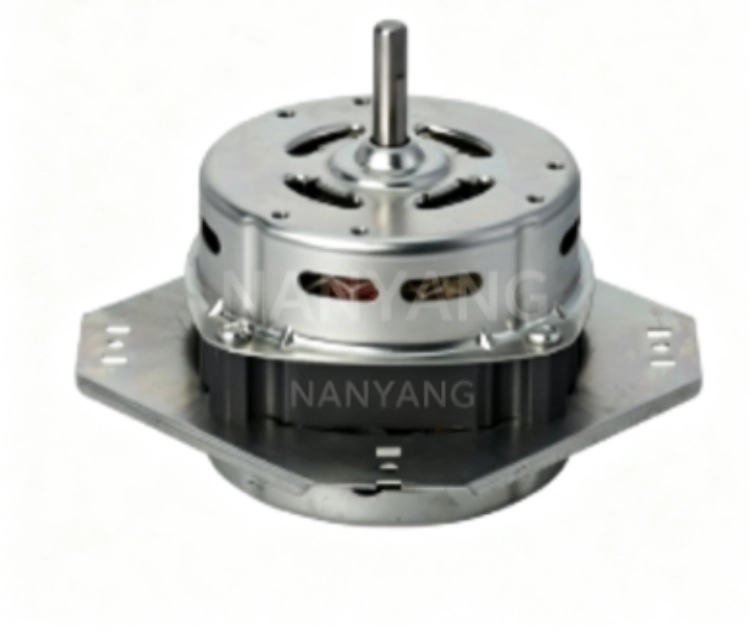
Nanyang’s motore spin is presented for twin-tub washing machine and spin-dryer applications. The official page lists a family of voltage, frequency, power, winding, insulation, pole, duty, noise, ambient, and altitude options. Those values define a product family; the chosen model must still be matched to the basket, brake, shaft, capacitor, and cabinet.
Two Motors Support Two Different Load Profiles
Washing creates a resisting load that changes with water level, textile movement, and reversal. Spinning creates a rising inertial load during acceleration and a strong sensitivity to imbalance at higher speed. These are not the same torque-speed requirement.
That is why a twin-tub machine may use two motors even when both operate from the same mains supply. Separate motors allow the designer to match each winding, shaft, mounting arrangement, and operating duty to one mechanism.
Why Wash and Spin Motors Are Not Direct Substitutes
The two products can look similar because both may be single-phase induction motors in compact appliance frames. Compatibility depends on more than appearance.
Shaft and Mounting Details Follow the Mechanism
Check shaft diameter, length, flats or key features, pulley or coupling, mounting-hole pattern, stack height, rotation direction, and clearance around the motor. A small shaft-height difference can disturb belt alignment or prevent the brake and spin basket from operating correctly.
Il Wash Motor product reference identifies twin-tub washing machines and single washers as intended applications. It should be evaluated against the wash mechanism drawing rather than used as evidence that the motor will also fit a spin assembly.
Starting and Running Conditions Are Different
A wash motor must repeatedly restart and reverse under a wet, variable load. A spin motor must accelerate the basket and then remain stable as speed rises. The capacitor, switch, winding, and protection arrangement must support the intended sequence.
Matching rated power alone does not prove that starting torque or current is suitable. Ask for the torque-speed behavior, current, temperature rise, and test conditions that represent the actual mechanism.
Duty Rating Must Match the Appliance Cycle
Product-family pages may list more than one service characteristic because different projects need different operating periods. The complete washer cycle determines how long each motor runs, how often it restarts, and how much cooling time is available.
Do not infer a permissible cycle from the motor name or from another model in the family. Record wash time, reversal interval, spin time, starts per hour, ambient temperature, airflow, and abnormal-load response in the requirement sheet.
How Should OEMs Specify the Two Motors?
A clear specification keeps the motor proposal tied to the complete appliance instead of a catalog label.
Start With the Driven Load
Describe tub capacity, wet-load range, pulsator or basket inertia, transmission ratio, target speed, acceleration time, reversal pattern, and braking method. Include the most difficult condition, such as a heavy wet load or an unbalanced spin basket.
If load data is incomplete, test the current motor and mechanism under controlled conditions. That baseline gives the supplier something measurable to match or improve.
Separate Electrical and Mechanical Approval
The electrical review should cover voltage, frequency, power, current, capacitor, winding option, insulation, thermal protection, duty, and wiring. The mechanical review should cover shaft, mounting, pulley or coupling, runout, balance, clearances, and rotation.
Use Nanyang’s testing capability as a starting point for discussing sample validation. Approval should include loaded starting, reversal or acceleration, temperature rise, noise, vibration, abnormal load, and repeated-cycle testing in the intended appliance.
Control Changes After the Sample Passes
Record the approved drawing, winding, capacitor, materials, shaft, mounting, connector, test method, and packaging. A change that appears minor can alter current, temperature, noise, assembly fit, or spin stability.
The supplier and buyer should agree on traceability and engineering-change notification before mass production. This protects the relationship between the validated motor and the washer revision that uses it.
Which Nanyang Motor Should You Evaluate?
Choose the official product reference that matches the mechanism, then provide the exact application data for confirmation.
Use the Spin Motor for the Spin-Dryer Mechanism
The official Nanyang Spin Motor range is the relevant starting point for a twin-tub spin basket or spin-dryer mechanism. Confirm the specific electrical option, shaft, mounting, duty, and driven-load requirements with the sales and engineering team.
Use the Wash Motor for the Washing Mechanism
The wash-side product should be evaluated around pulsator or agitator load, repeated reversal, and the required wash timer sequence. Even when electrical ranges overlap, keep the wash and spin part numbers, drawings, and test records separate.
Approve Both Motors in the Complete Washer
Bench tests are useful, but final approval should happen in the intended washer. The cabinet, belt or coupling, brake, water load, textile distribution, ventilation, and mounting stiffness can change current, temperature, noise, and vibration.
Conclusione
A wash motor drives the washing action, while a spin motor drives the water-extraction basket. Their load profiles, shafts, starting conditions, duty, and validation tests are different, so they should not be substituted on the basis of voltage, wattage, or appearance alone. For a twin-tub project, define each mechanism separately, test both motors in the finished appliance, and use the Pagina dei contatti di Nanyang to submit the two requirement sets for confirmation.
Domande frequenti
Q1: How many motors does a twin-tub washing machine have?
A1: It commonly has a wash motor for the washing tub and a spin motor for the separate extraction basket.
Q2: Can a wash motor replace a spin motor?
A2: Not automatically, because the shaft, mounting, starting behavior, torque-speed curve, duty, and driven mechanism may differ.
Q3: Why does the wash motor reverse direction?
A3: Reversal changes the pulsator or agitator motion so water and textiles move through the washing cycle.
Q4: What should buyers compare besides motor power?
A4: Compare voltage, frequency, current, capacitor, torque, speed, duty, shaft, mounting, rotation, temperature, noise, and load testing.
Q5: Should wash and spin motors be tested separately?
A5: Yes, but both should also be validated in the complete washer because the installed mechanisms create different loads and vibration conditions.